
Stocktake in the web backend lets you count your physical inventory, compare it against system-expected quantities, and post adjustments so stock levels match what's actually on the shelf. The new module is built around smaller, frequent counts: a quick walkaround or single-category count catches shrink earlier than one full annual count. The lifecycle is: start a count → enter counts → review variance → post adjustments, with drafts available at any point.
⚠️ Important. Items not added to a count are not changed. Stock for unaccounted items stays as-is, a partial count never touches quantities for products you didn't count.
📝 Note. The previous version of the module remains available as Old Stocktake in the left navigation, directly below the new Stocktake, so historical counts stay accessible during the transition.
Where to find it
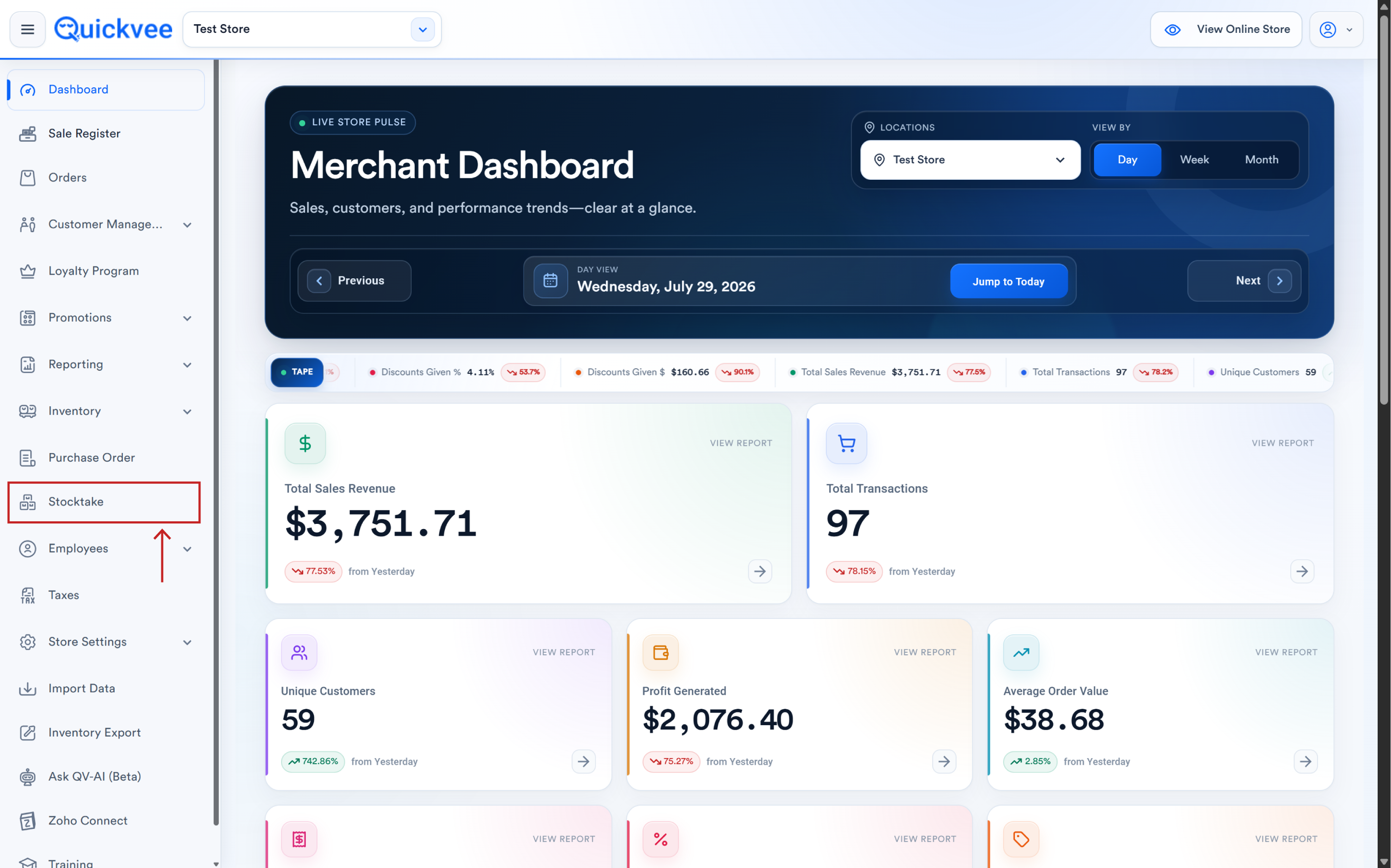
Open Stocktake from the left navigation of your store backend (in store context, the header shows your active store selector and Back to Super Admin). The header reads Count physical inventory, review variance, post adjustments, with a + New count button on the right.
The Stocktake dashboard
-20260805-114853.png?cb=926107c228093504beba18609e3919a9)
|
Card |
What it shows |
|---|---|
|
Active Counts |
Counts currently in progress |
|
Pending Review |
Counts ready to post |
|
Shrink (30d) |
Dollar value of loss adjustments over the last 30 days |
|
Overage (30d) |
Dollar value of gain adjustments over the last 30 days |
Below the cards, status tabs (All, In progress, Ready to post, Posted, Void) each show their count, alongside a scope dropdown filter and a Search counts box. The counts table lists each count's name and ID (for example ST0178), Scope, Counter (who's counting), Status, Progress (items counted), unit Variance, and $ Variance. In-progress counts with no activity can be deleted from the row; click any row to open it.
Starting a new count
-
Click + New count.
-20260805-114917.png?cb=926107c228093504beba18609e3919a9)
-
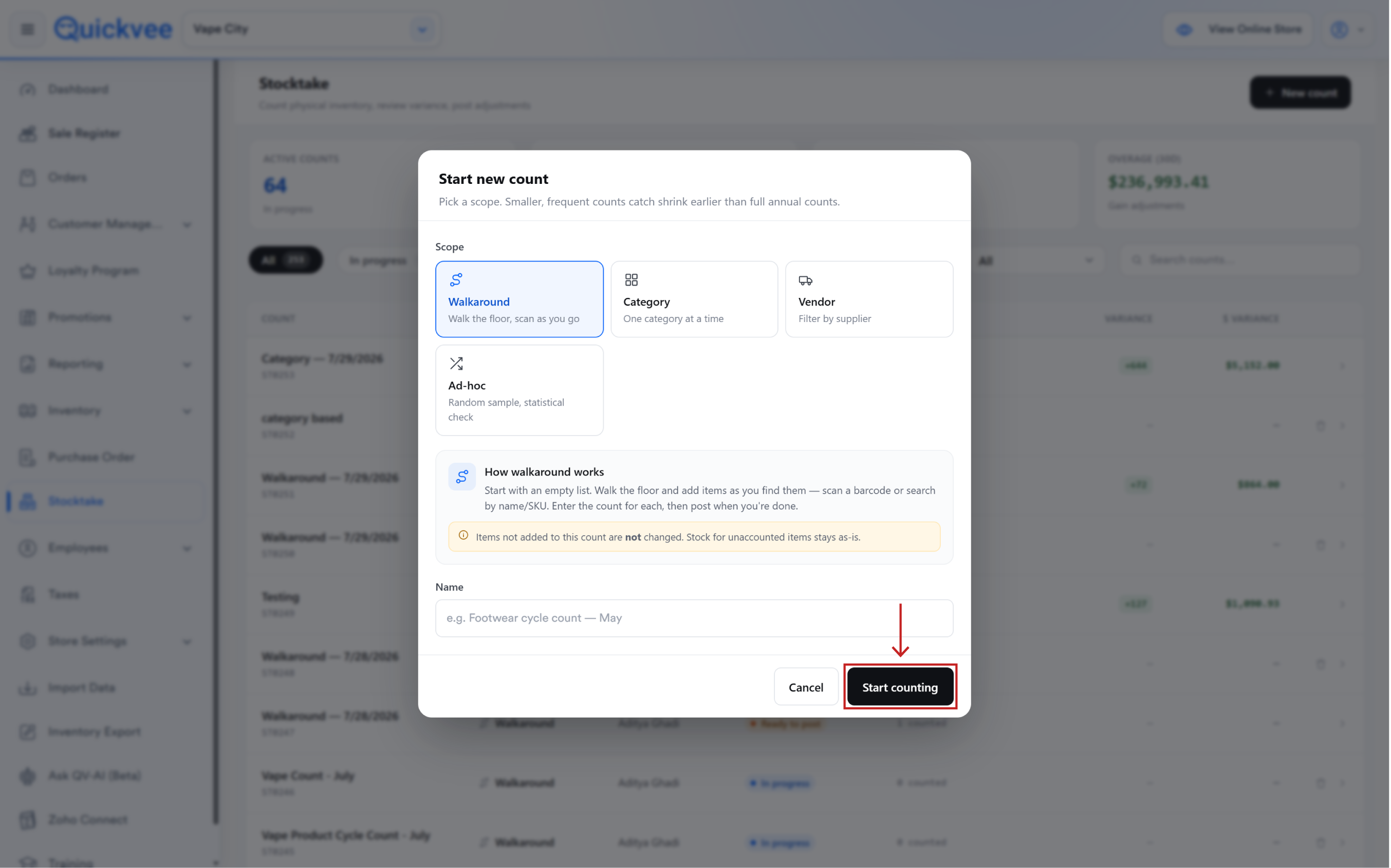
In the Start new count dialog, pick a Scope.
|
Scope |
Description |
Extra options |
|---|---|---|
|
Walkaround |
Walk the floor, scan as you go. Start with an empty list, add items as you find them (scan a barcode or search by name/SKU), enter the count for each, then post when done. |
None |
|
Category |
One category at a time. |
Select a category dropdown. |
|
Vendor |
Filter by supplier. |
Select vendor dropdown. |
|
Ad-hoc |
Random sample or statistical check. The system picks random products for you. |
Sample size stepper with quick picks (5 / 10 / 15 / 25 / 50). You can also scan items not in the list, they'll be added on the fly. |
-
Optionally name the count (for example, Footwear cycle count, May).
-
Click Start counting. The button stays disabled until the scope's requirements are met (for example, a category or vendor is selected).
✅ Best practice. Rotate small scoped counts through the week, a vendor count on delivery day, a category count during slow hours, instead of one exhausting full count.
Entering counts
The count screen shows the count name, ID, and status chip, with Count entries and Variance review tabs, plus Export, Save as Draft, and Post adjustments buttons. A summary strip tracks X items added · Y counted with running LOSS, GAIN, MATCH, and PENDING badges.
-
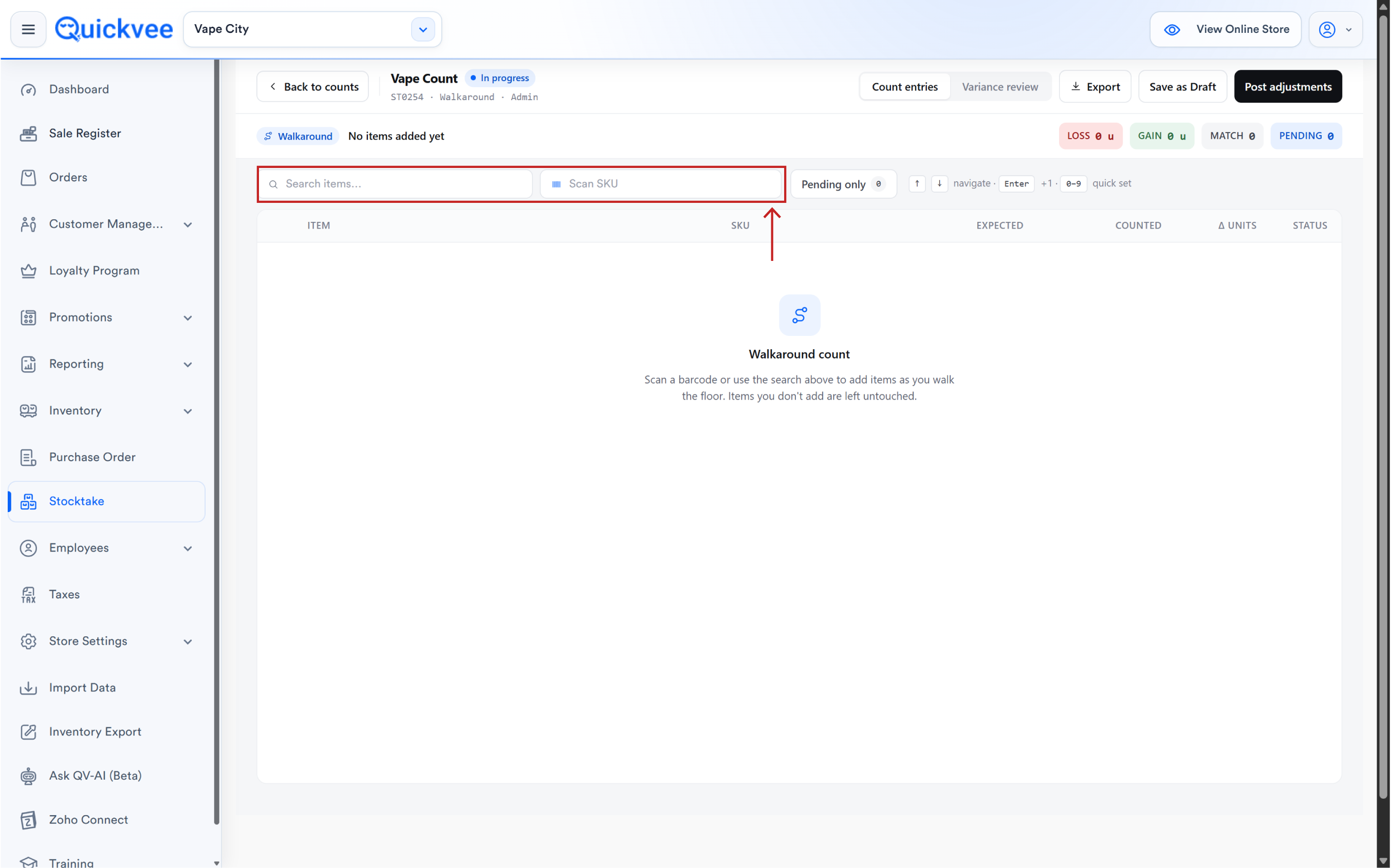
Add items via the Search items box or the Scan SKU field. Under + Add from Catalog, click + on any product to add it. Use Pending only to filter to items not yet counted.
-
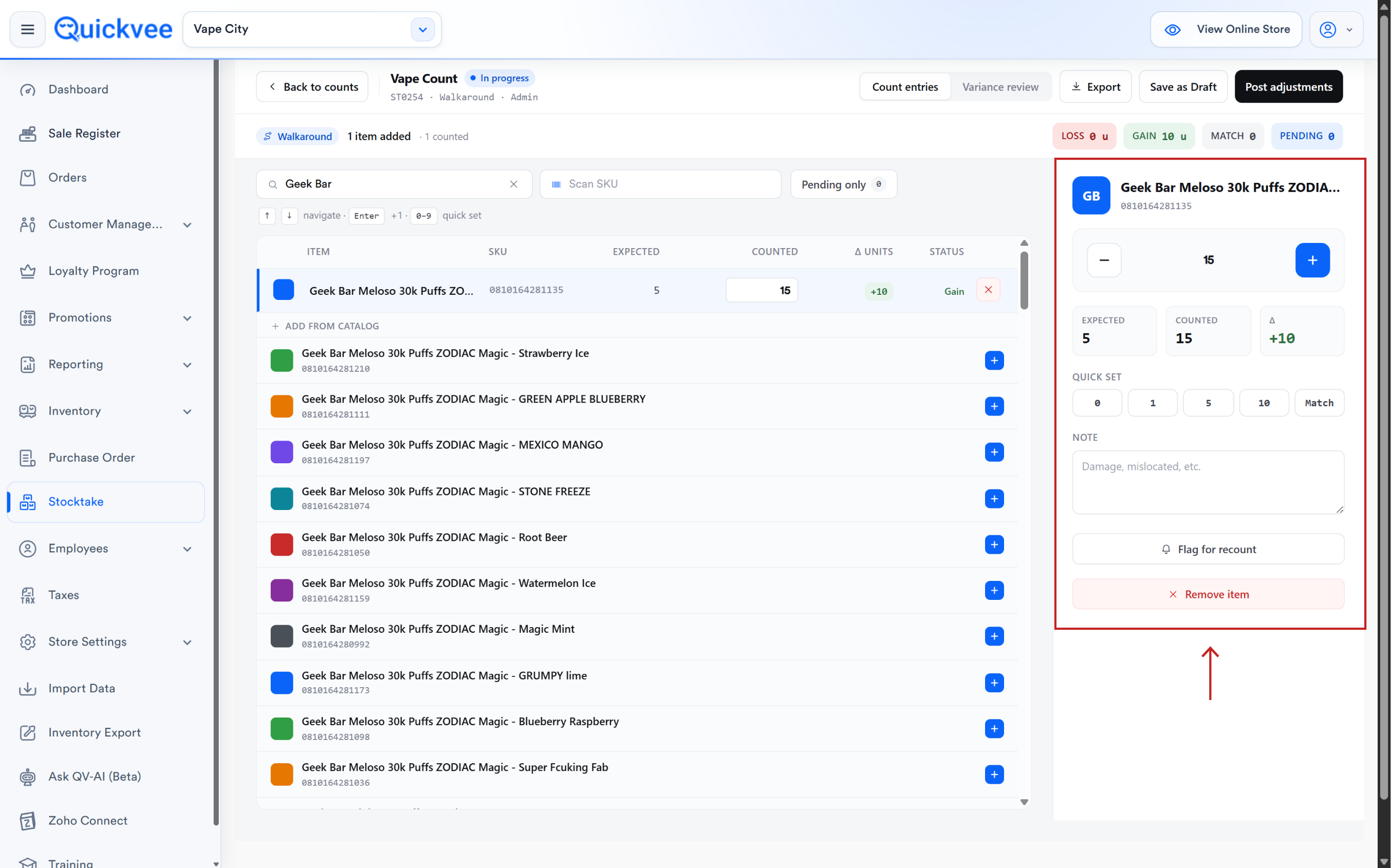
Select a row and enter the counted quantity, directly in the Counted cell, or in the right-hand item panel using the − / + stepper. The panel shows Expected, Counted, and Δ side by side.
-
Use Quick Set buttons (0, 1, 5, 10, Match) for one-click entries. Match sets the count to the expected quantity.
-
Each row shows Expected, Counted, Δ Units, and a status chip (Gain, Loss, or Match). Remove a mistakenly added row with its delete icon, or use Clear count in the panel to reset an entry.
Built for speed on a keyboard: ↑ / ↓ navigate rows, Enter adds +1 to the selected item, and 0–9 quick-set quantities, so a scanner-plus-keyboard station can move through a count without touching the mouse.
💡 Tip. Use the Note field ("Damage, mislocated, etc.") to record context on an item while it's fresh, and Flag for recount to mark anything suspicious. The row shows a RECOUNT badge so a second pair of eyes can re-verify before posting.
If you navigate away with unsaved quantities, the Unsaved changes prompt offers Stay and keep editing or Save as Draft. Drafts preserve your entries for a later session.
Reviewing variance
Switch to Variance review before posting.
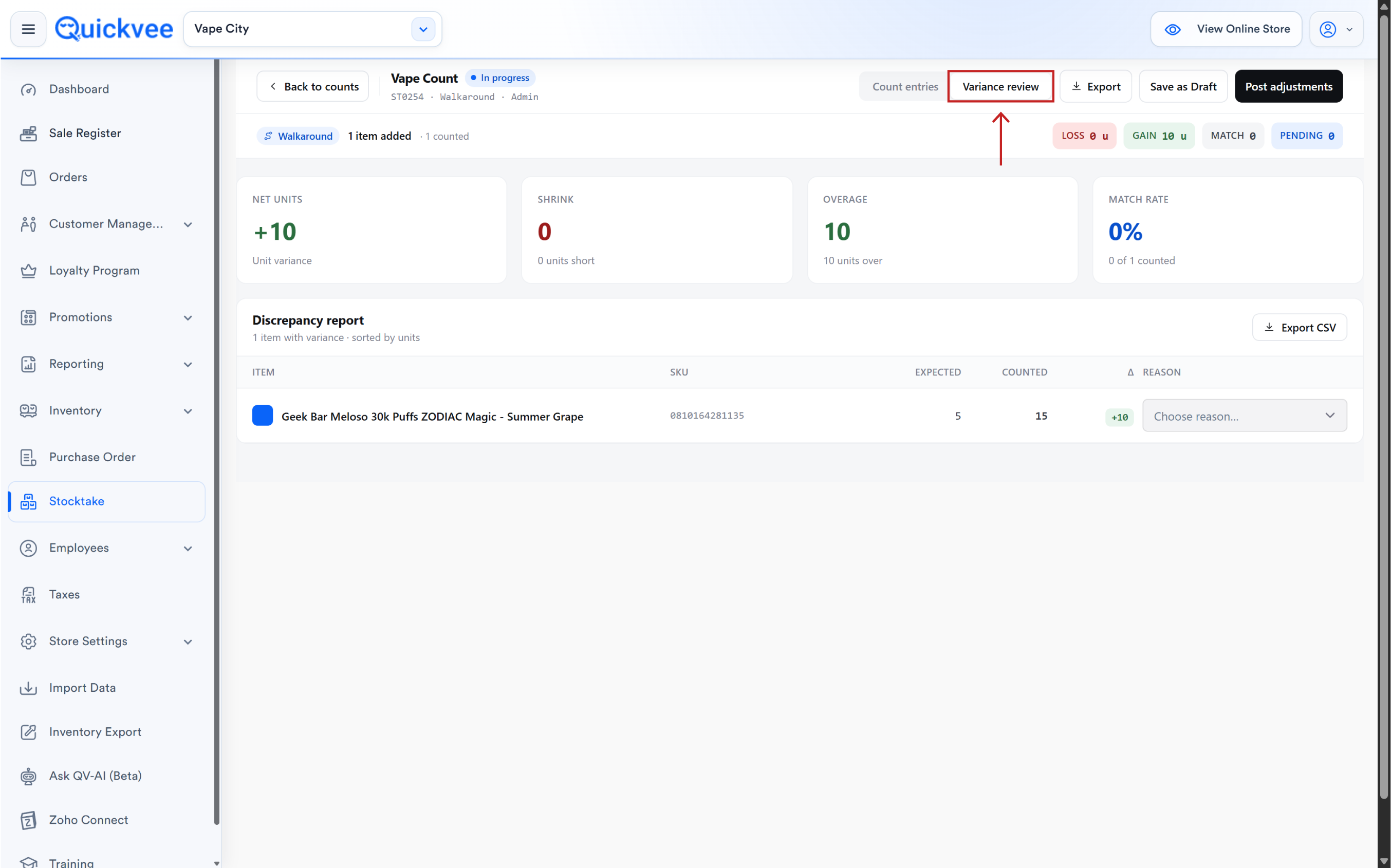
|
Card |
Meaning |
|---|---|
|
Net Units |
Overall unit variance (overage minus shrink) |
|
Shrink |
Units short, counted less than expected |
|
Overage |
Units over, counted more than expected |
|
Match Rate |
Portion of counted items that matched expected exactly (for example, 1 of 4 counted) |
The Discrepancy report lists every item with variance, sorted by units, with Item, SKU, Expected, Counted, Δ, and a Choose reason dropdown for attributing each discrepancy. Export CSV takes the report offline; the header Export button exports the count itself.
💡 Tip. Attribute reasons before posting. Reason data is what turns a variance number into an answer (damage vs. theft vs. receiving error) when you review shrink trends later.
Posting the count
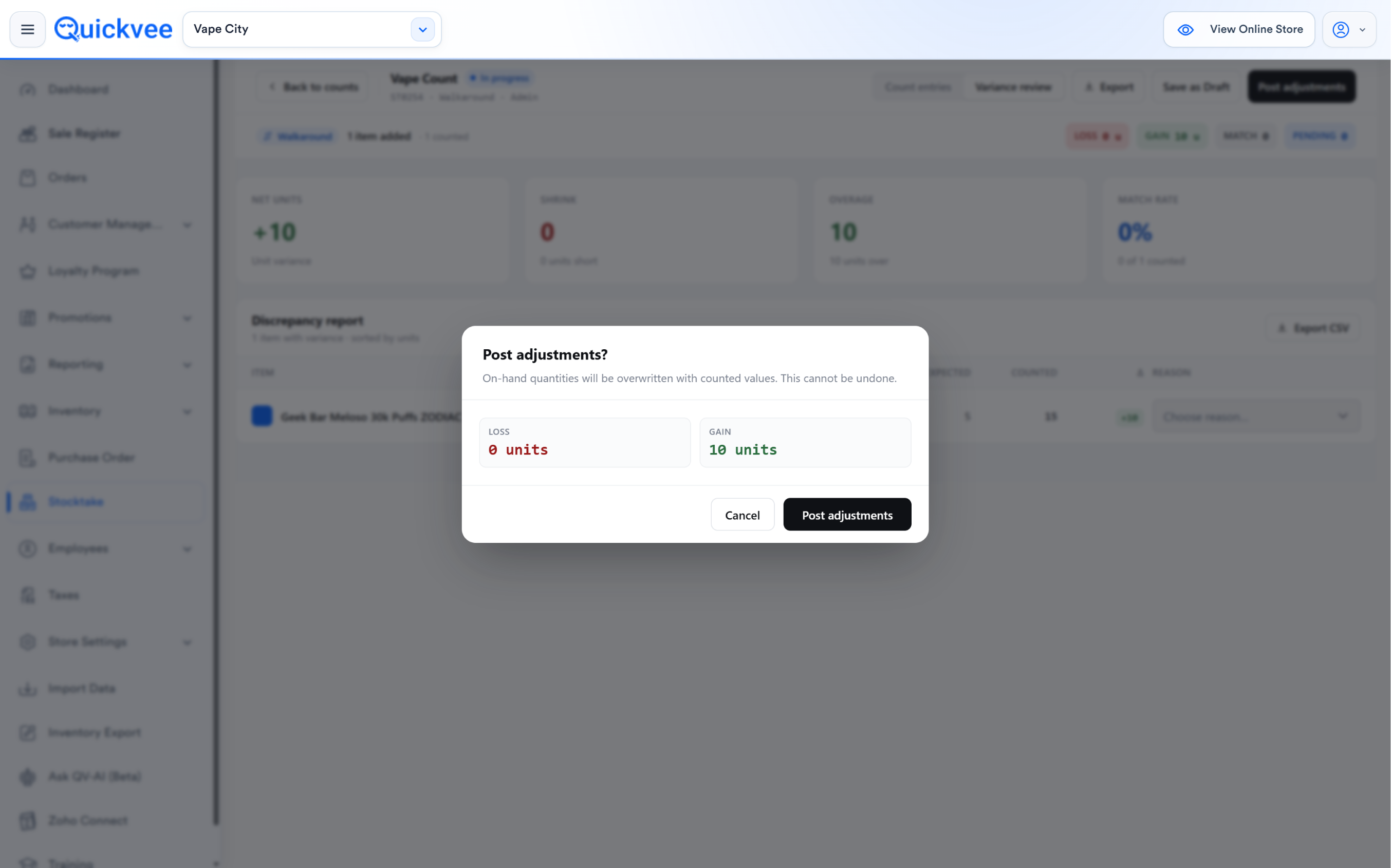
When the count reads Ready to post, click Post adjustments. Stock levels update to the counted quantities for every counted item, and the count moves to Posted on the dashboard with its final unit and dollar variance. Counts that shouldn't apply can be voided; voided counts sit under the Void tab.
Related
See Run a stocktake on the POS for the same workflow at the register.